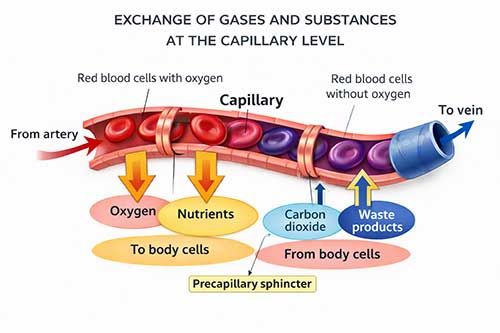
Healthy blood circulation is not simply the movement of blood. It is the continuous delivery of oxygen, nutrients, hormones, and heat to the tissues, together with the removal of carbon dioxide and metabolic waste products.
This process is known as microcirculation.
The Circulatory System: One Organ Serving Every Cell
The circulatory system is often viewed as a collection of separate vessels.
In reality, it functions as a single organ.
Arteries, veins, and millions of capillaries form one integrated network reaching every muscle, gland, nerve, organ, and tissue in the human body.
No cell exists outside this network.
Every process of growth, repair, recovery, and renewal depends upon healthy capillary circulation.
For this reason, Dr. Alexander Zalmanov considered the capillary system one of the most important foundations of health. Why Microcirculation Matters
The capillaries perform two essential functions.
- First, they nourish the tissues.
Oxygen and nutrients pass from the bloodstream into the cells.
- Second, they remove the products of cellular activity.
Waste materials, metabolic by-products, and carbon dioxide are carried away for elimination.
Without efficient microcirculation, neither nourishment nor cleansing can occur properly.
The condition of the capillary network influences the condition of the entire organism.
This is why supporting microcirculation naturally has long been a central goal of traditional circulation therapy.
Natural Ways to Support Circulation
Healthy circulation is influenced by many factors:
- Regular physical activity
- Heat exposure
- Proper hydration
- Healthy nutrition
- Deep breathing
- Hydrotherapy
- Stress management
Among traditional circulation-support methods, hydrotherapy with turpentine bath occupies a special place because it acts directly through the skin and its vast capillary network.